
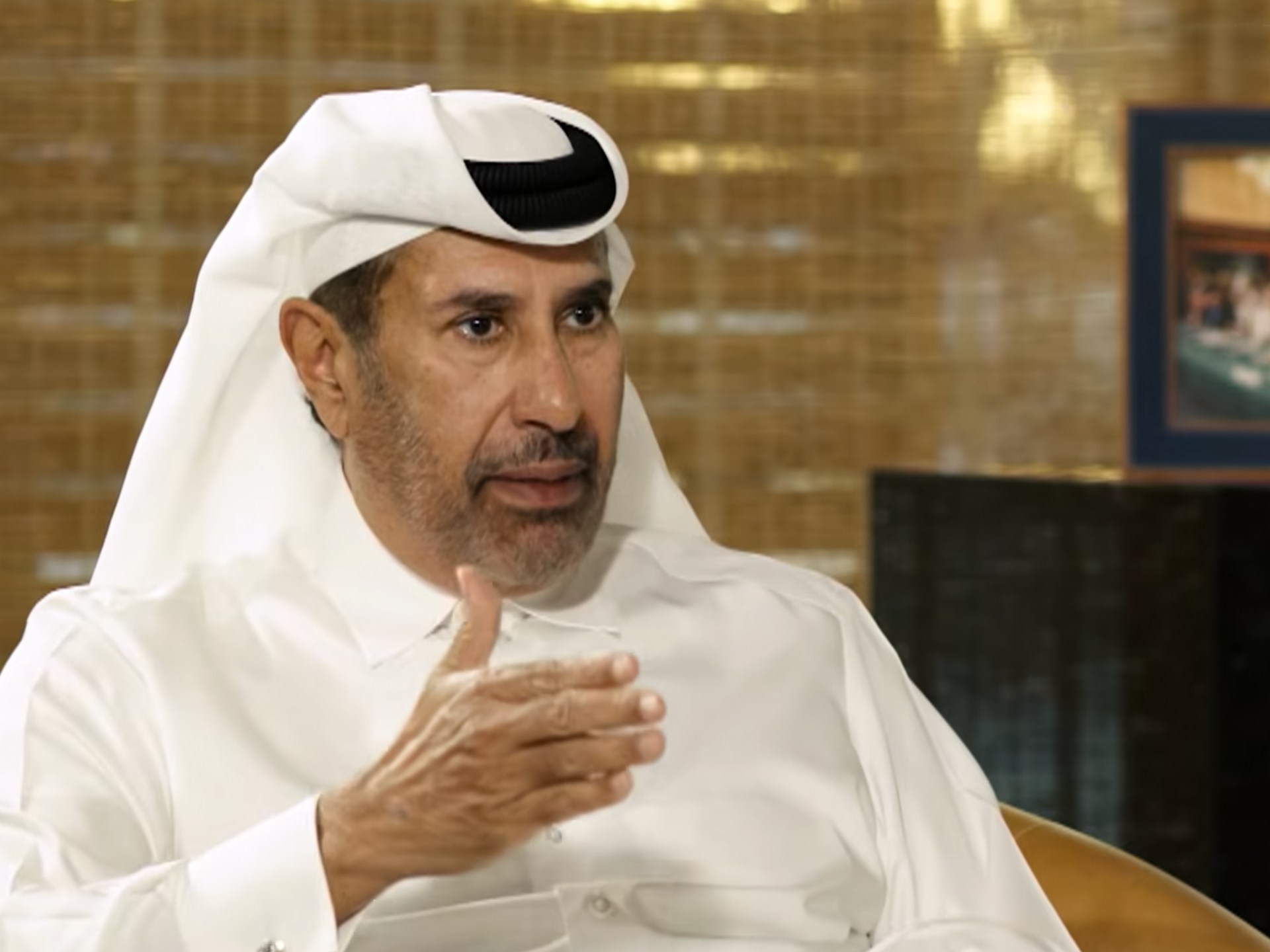
Former Qatar PM: Netanyahu using Iran war to reshape Middle East | Benjamin Netanyahu News
-
- 24

The United States-Israel war on Iran is not the result of a sudden escalation but the culmination of a long-term Israeli agenda to violently reshape the Middle East, former Qatari Prime Minister and Foreign Minister Sheikh Hamad bin Jassim Al Thani tells Al Jazeera.
In a wide-ranging, candid interview on Al Jazeera’s Al Muqabala programme, the veteran diplomat offered a stark assessment of the region’s rapidly shifting geopolitical landscape. He warned that the crisis in the Strait of Hormuz is the most perilous consequence of the recent war, cautioned against Israeli Prime Minister Benjamin Netanyahu’s ambitions for a “Greater Israel” and called for the urgent establishment of a unified Gulf defence pact.
“We are witnessing a major restructuring of the region,” Sheikh Hamad said, noting that the current geopolitical tremors will dictate the shape of the Middle East for decades to come.
Netanyahu’s ‘illusion’ and the US misstep
Sheikh Hamad had warned of an impending conflict last year and urged Gulf states to push for a diplomatic resolution to resolve the crisis with Iran and prevent military strikes.
He identified a push for a conflict with Iran and blamed it on a “hardline faction” within Israel led by Netanyahu, who he said had been trying to drag the US into a war over Tehran’s nuclear programme since President Bill Clinton’s administration in the 1990s.
While previous US governments – including during President Donald Trump’s first term – hesitated to launch a full-scale war on Iran, Netanyahu finally succeeded by selling Washington an “illusion”, Sheikh Hamad argued. “He convinced the US administration that the war would be short and swift and that the Iranian regime would fall within weeks,” he said, drawing parallels to failed US efforts to change Venezuela’s government.
The former Qatari premier criticised Washington’s reliance on military might, saying, “America’s true power has always been in its ability to avoid using force, not in deploying it.” He noted that the current war ultimately has forced all parties back to the negotiating table, suggesting that an additional two weeks of talks in Geneva early this year – an Oman-led diplomatic push to avoid war – could have averted the catastrophe altogether.
Netanyahu has emerged as the primary beneficiary of the war, Sheikh Hamad observed, saying the Israeli leader is using the chaos to market his vision of forced regional alliances and a “Greater Israel”, a plan among Israel’s right wing to expand the country’s borders deeper into neighbouring Arab states.

The Strait of Hormuz: A new global flashpoint
Assessing Tehran’s strategy, Sheikh Hamad said Iran successfully absorbed the initial military strikes of the war and subsequently dragged its feet on a settlement after realising it could leverage a new strategic advantage: the Strait of Hormuz.
Calling the weaponisation of the waterway the “most dangerous outcome” of the war, he warned that Iran is now treating the vital international chokepoint as its own sovereign territory. This, he argued, poses a more immediate and severe threat to global economies than the Iranian nuclear programme.
The Gulf states, rather than Washington, have borne the brunt of this crisis, Sheikh Hamad said, and the former prime minister harshly condemned Iran’s attacks on Gulf energy, industrial and civilian infrastructure under what he said was the guise of targeting US interests, noting that these Gulf nations had explicitly opposed the war.
As a result, Tehran has exhausted much of its political capital in the Gulf, generating widespread public anger over the economic and security disruptions its actions have caused. However, Sheikh Hamad stressed that geography dictates coexistence and called for a frank, collective Gulf dialogue with Tehran rather than fragmented unilateral communications to establish a realistic framework for the future.
A call for a ‘Gulf NATO’
In one of his most blunt assessments, Sheikh Hamad declared that the greatest threat to the Gulf is neither Iran, Israel nor foreign military bases but internal Gulf disunity.
To counter this, he proposed the creation of a “Gulf NATO”, a joint political and defence project starting with a core group of strategically aligned Gulf nations with Saudi Arabia serving as its natural backbone. He argued that the European Union began with a small number of states before expanding, suggesting a similar model governed by strict institutionalised laws respected by all members.
Addressing the US military presence, Sheikh Hamad acknowledged that US bases have provided crucial deterrence for decades. However, he warned that Washington’s strategic pivot towards Asia and the containment of China means the Gulf can no longer rely indefinitely on the US security umbrella, and he urged Gulf states to develop long-term, interest-based strategic partnerships with regional powers such as Turkiye, Pakistan and Egypt.
Gaza, normalisation and a late-1990s secret
Turning to the issue of Palestine, Sheikh Hamad condemned the killing of civilians on all sides but accused Israel of committing a “moral and political disaster” in Gaza, where more than 72,500 Palestinians have been killed since Israel’s genocidal war began in October 2023. He warned of an Israeli plot to depopulate the strip, citing intelligence that money is being offered to encourage Palestinians to leave the enclave, which he said, in effect, is turning Gaza into a real estate project.
While acknowledging the unprecedented global sympathy the Palestinian cause has garnered since October 7, 2023, particularly in the West, he cautioned Palestinian factions, including Hamas, to carefully weigh the devastating human cost.
He firmly rejected any discussion of disarming Hamas without a guaranteed political horizon for an independent Palestinian state and praised Saudi Arabia’s steadfast refusal to normalise relations with Israel without a roadmap for this – a stance, he said, that deeply disrupted Netanyahu’s regional calculations.
Reflecting on recent regional shifts, Sheikh Hamad expressed relief at the fall of Bashar al-Assad’s regime in Syria, revealing that he had personally advised the former president early in the revolution to listen to his people. He praised the pragmatism of the new Syrian leadership in avoiding Israeli provocations and urged it to focus on economic and institutional rebuilding after nearly 14 years of war and mismanagement by al-Assad’s government.
The interview also unveiled a piece of hidden diplomatic history. Sheikh Hamad disclosed that in the late 1990s, the Qatari leadership dispatched him to Tehran to deliver a message from the Clinton administration. The US demanded that Iran hand over its nascent nuclear programme to Russia or submit to international arrangements.
While Qatar acted strictly as a messenger, Tehran at the time viewed Doha as aligned with the American stance, he noted.

Bagian yang kuat, saya sekadar memberikannya kepada seorang rekan yang sedang melakukan agak evaluasi tentang ini. Dan dia sesungguhnya membeli saya sarapan sebagai hasil dari saya menemukannya untuknya.. senyum. Jadi biar saya ulangi: Terima kasih untuk traktiran! Namun ya terima kasih telah meluangkan waktu untuk mendiskusikan ini, saya benar-benar merasa kuat tentang hal ini dan suka membaca tambahan tentang topik ini. Jika bisa dilakukan, seiring Anda berkembang menjadi lebih ahli, apakah Anda keberatan memperbarui blog Anda dengan tambahan rincian? Ini sangat berguna bagi saya. Jempol luar biasa untuk kiriman weblog ini!
Wow, hebat blog struktur! Sudah berapa lama Anda ngeblog? Anda membuat blogging terlihat mudah. Seluruh tampilan web site Anda luar biasa, serta materinya!
Anda sudah melakukan pekerjaan yang tangguh dan seluruh komunitas kami akan berterima kasih kepada Anda.
Anda telah melakukan pekerjaan yang tangguh dan seluruh komunitas kami akan bersyukur kepada Anda.
You are my aspiration, I have few blogs and sometimes run out from to brand : (.
Throughout this awesome pattern of things you actually get a B+ just for hard work. Exactly where you misplaced me was on the facts. You know, people say, details make or break the argument.. And that could not be much more accurate here. Having said that, permit me inform you what did do the job. Your article (parts of it) is highly powerful and that is probably why I am taking the effort to opine. I do not make it a regular habit of doing that. 2nd, even though I can certainly see a leaps in reasoning you make, I am not necessarily convinced of just how you appear to connect the details that make your final result. For now I will, no doubt yield to your position but wish in the future you actually connect your facts much better.
Ini adalah blog yang tepat untuk siapa saja yang ingin mencari tahu tentang topik ini. Anda menyadari begitu banyak hal sehingga nyaris sulit untuk membantah dengan Anda (bukan berarti saya benar-benar ingin…HaHa). Anda benar-benar memberikan pendekatan baru pada topik yang telah ditulis selama bertahun-tahun. Luar biasa, benar-benar luar biasa!
Halo semua, saya menemukan website Anda melalui Google ketika menelusuri subjek yang serupa, website Anda tampil di hasil teratas. Saya harus mengatakan bahwa saya terkejut seberapa baik penyusunannya. Saya sangat menikmati menelusuri ini dan saya pasti akan kembali untuk melihat lebih banyak. Terima kasih banyak!